Over the past months, the framework that originally made this project possible has changed. In direct communication, the organiser made it clear that cars like ours are no longer wanted at the 24h Nürburgring. We were further informed that our participation is now subject to “unpredictable factors” and additional, non‑transparent considerations.
One and a half years ago, RauhRacing approached the responsible bodies around the 24 Hours of Nürburgring with a simple question: would a Renault Twingo, built to a clearly defined specification, be a viable entry for the race. We did what a small private teamis expected to do: ask first, plan properly, and only then start building.
In response, we received written confirmation that nothing speaks against entering a Twingo at the 24h Nürburgring. On the basis of that statement, we made a fundamental decision: to go all in. We committed to building the car to the specification we had disclosed to the organiser, and to investing our time, savings, and reputation into making that promise real.
At that point, RauhRacing was a bucket‑list idea between two brothers who love cars and racing. Within twelve months, that idea turned into a fully regulation‑compliant race car for the SP class, a team built entirely from scratch, a community of more than 75,000 people following the project, a 200‑strong Discord server actively contributing, volunteers spending their evenings in the workshop, and partners who committed because they wanted to see this Twingo race. None of this came from excess budget or existing infrastructure, but from limited means, full‑time jobs, late nights, and a significant amount of personal sacrifice.
Over the past months, the framework that originally made this project possible has changed. In direct communication, the organiser made it clear that cars like ours are no longer wanted at the 24h Nürburgring. We were further informed that our participation is now subject to “unpredictable factors” and additional, non‑transparent considerations. Taken together, those messages leave very little room for interpretation.
Preparing properly for the 24h Nürburgring 2026 would require committing a high five‑figure budget in the coming months, with no external financial backing, on top of the time constraints and mental load that come with running this project alongside regular employment. Committing that level of money, time, and health to an outcome thatis no longer clearly tied to preparation, or regulatory compliance would be a gamble we cannot justify.
For this reason, despite our car being fully compliant with the current regulations and ready to race, RauhRacing will not commit to the upcoming 24 Hours of Nürburgring with the Twingo. This was not an easy decision and took a few months to coordinate. The following sections explain how this situation developed, what it reveals about the conditions facing private teams, and how the project will continue beyond this decision.
In 2024, we contacted the relevant sporting authorities and the organiser of the 24h Nürburgring for the first time with a concrete concept: a Renault Twingo, built to SP‑class regulations, with clearly defined power figures and safety equipment. The purpose was simple: to clarify in advance whether such a car would be eligible to enter the race before we invested time and money.
Shortly afterwards, we received written confirmation that “nothing speaks against entering a Twingo at the 24h Nürburgring”. On the strength of that statement, we locked in our direction, and we committed to building the car exactly to that brief, rather than chasing extra performance or cutting corners.
From that point on, every major decision followed the same logic:
- We sourced and prepared a shell that could be brought in line with the DMSB regulations for the relevant class (SP3).
- We invested in safety hardware, chassis work, and engine upgrades within the framework we had declared to the organiser.
- We built a team structure capable of running a 24‑hour program, including 6 core team members and over 10 regular volunteers.
- We began the necessary permit, licensing, and test steps required to race at the Nürburgring in endurance events.
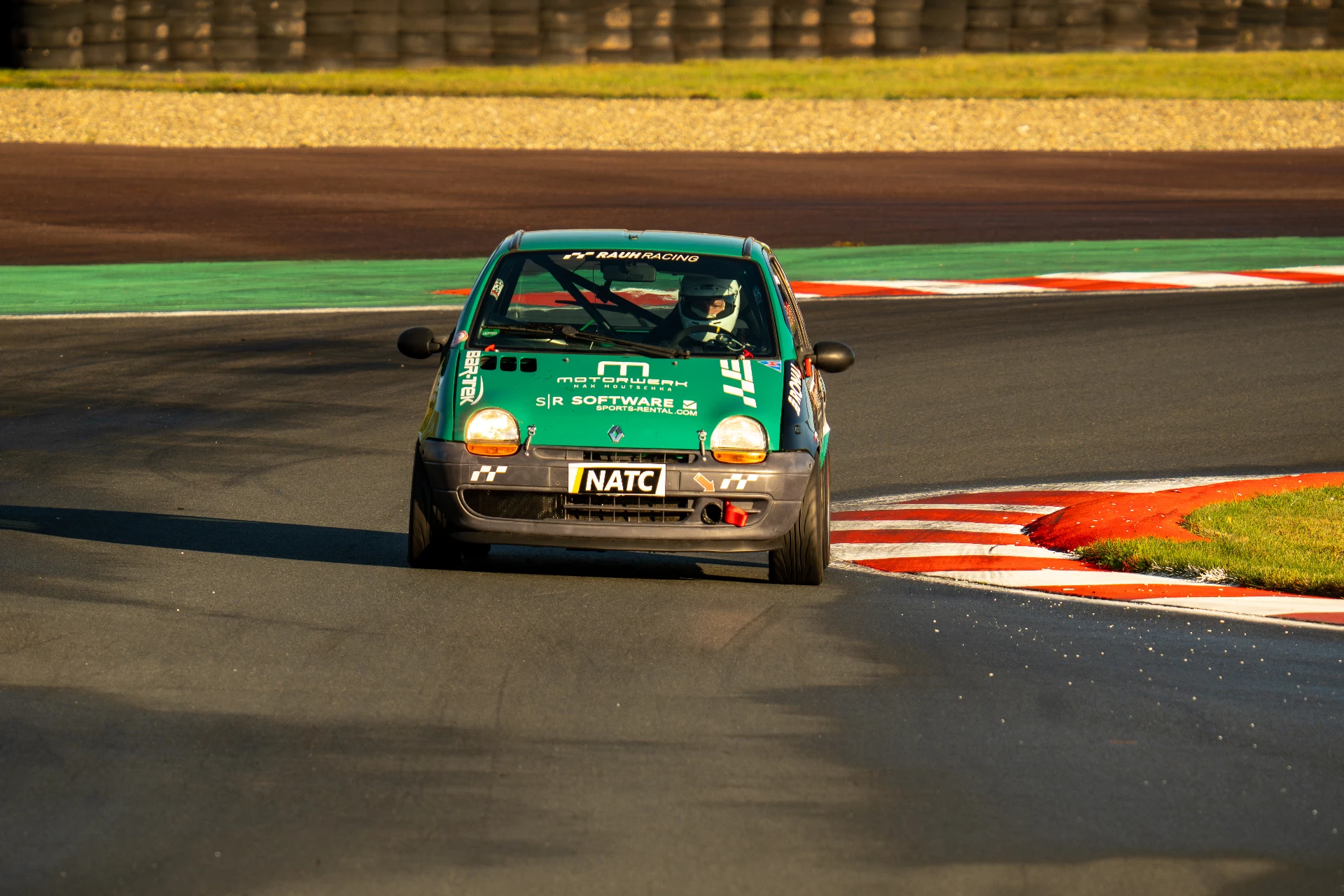
By Autumn 2025, the car existed in its current form: a 24h‑regulation‑compliant Twingo, matching the technical specification we had communicated from the outset. At the same time, the project had grown into a wider ecosystem, with a following of more than 75,000 people, and partners who came on board specifically because the car was pointed at the 24h Nürburgring.
It was only after these commitments had been made, that the tone of the conversations with the organiser changed. In September 2025, we were informed that cars like ours were no longer wanted onthe grid and that, despite our compliance with the written regulations, anentry could not be relied on. That shift is what ultimately brought us to the decision outlined in this statement.
We asked the German motorsport authority in writing if our Twingo, built to the SP3 rules, could in principle race the 24h Nürburgring. The official answer, after they checked with the race organizer, was: there is “no objection” as long as we follow the existing regulations.
Before spending serious money, we emailed the responsible person at the organizer to clarify details of the SP3 rulebook for our car. We received technical, constructive answers and started building the car precisely to those guidelines. Nobody said the concept itself was a problem or unsafe.
On the back of that written “no objection” and the technical feedback, we invested a high five‑figure sum, bought parts and publicly shared our plan to race the car at the 24h Nürburgring in SP3. From our side, we were simply doing what had been agreed: build a compliant car for an existing class.
On 4 September, we received an email from the organizer stating that “no one” from our team had ever contacted them, even though there was a written “no objection” from 2024 and a documented technical exchange with that exact representative in February 2025. In the same email, they describe our car as a “potential safety risk”, say that no entry for the 24h race can be expected, and ask us to stop making any public statements suggesting we will race there
We replied by sending them their own history: the DMSB confirmation from 2024 (after consulting the organizer) and the February 2025 emails where we explicitly wrote that we plan to race a Twingo in SP3 at the 24h Nürburgring. Despite this, the organizer continued to insist that we had not approached them “properly” and demanded a formal project presentation as if this were a standard requirement; even though, as we later learned from other teams, this kind of extra step is not normally asked for, nor is it outlined anywhere as a requirement. It was at this point that we also received the clear message from the organizer that they do not want cars like ours (i.e. Sub-GT4 like the Manta, Dacia, and Twingo) at the Nürburgring 24h anymore. When pressed, the organizer could not provide any substantial reasons. Nor did the organizer have any clear answer to the question as to why existing teams with similar cars (e.g. Dacia Logan, BMW E36 318ti) can continue to race, but new entrants of the same classes are not welcome.
As requested on the phone, we put together a detailed project presentation about the car, the technical concept and our plan, and sent it to the organizer a month before the agreed meeting date, to give them every chance to review it properly in advance.
By the time we sat down with the organizer, it became obvious that our presentation had either not been read or not been taken seriously: people in the room acted as if they had never really seen the deck they had insisted on, and the conversation quickly became chaotic and inconsistent. Instead of concrete rule violations, we faced a mix of vague doubts about our car’s size and performance, references to past incidents with completely different cars and the message that similar “slow” cars could continue under grandfathering while our new, compliant project should be held back.
Preparing properly for a 24‑hour race at the Nürburgring is not something that can be decided a few weeks before the start. It requires committing a high five‑figure budget many months in advance, for engine work, reliability upgrades, tyres, entry fees, testing, logistics, and the people needed to run the car around the clock. For a small team like ours, that money does not come from a manufacturer budget, but from private savings, limited sponsorship, and a community that trusts us to make responsible decisions.
Alongside the finances, there is the reality of time and capacity. RauhRacing is built around full‑time jobs, aworkshop that has to be shared with other projects, and volunteers who give up evenings and weekends. The mental load of coordinating a programme like this is already high when the framework is stable. Adding the possibility that, after all of that, an entry could still be refused on arbitrary factors changes the calculation completely.
Motorsport will always involve risk. Parts can fail, weather can change, strategy can go wrong, and you can be taken out in someone else’s accident. Those are risks we accept. What we cannot accept is a scenario where we commit tens of thousands of euros, months of work, and our own health to a project where the decisive factor is no longer our preparation, but informal, shifting conditions that we cannot influence or even fully understand. That is not a brave underdog story, but a gamble with consequences far beyond one race weekend.
Against the backdrop of the challenges motorsport already faces, selective and opaque decision‑making towards the remaining grassroots entries accelerates a development that many people already sense: the slow disappearance of broad‑based, diverse grids. In a lot of series, most of the grid is made up of very wealthy entrants for whom racing is primarily an expensive hobby, alongside factory or factory‑supported programmes. Between those poles, only a handful of genuine privateer teams remain.
Those few teams are often presented as proof that “everyone is welcome” and that the grid is still diverse – the small heroes in the background of the big show. In reality, this picture is becoming harder to sustain. Outside a small number of private operations that are used to support this narrative, there is not much left of the broad grassroots motorsport that is still invoked in marketing around the 24h Nürburgring. This is rarely addressed publicly, and for the very small teams who are affected, speaking up is risky, because there are only a few major organisers and events to race with.
For us, the calculation is different. Our project has always been built on transparency and a different way of telling the story. That puts us in a position where it makes sense to address these issues openly, even if it comes with consequences. If teams that still try to enter with unconventional cars and realistic private budgets never say anything, the space for projects like this will simply disappear in silence.
We understand that no organiser is obliged to accept every car or every entry. Grid size, safety, logistics, and commercial interests all have to be managed. Our concern is not that standards exist, but that they are increasingly applied in ways that are informal, selective, and difficult to understand for the teams affected by them.
In speaking to other small and private teams over the past months, we have heard very similar stories of shifting requirements, late changes, and unclear communication around entries. In some cases, teams report being confronted with assumptions about their cars or performance that contradict the technical paperwork, or being held to new conditions while others keep their place on the grid under grandfathering. When the public image is one of openness and diversity, but the reality quietly filters out certain types of cars and teams, the result is a paddock that becomes narrower and less diverse over time. We do not believe that is in the long‑term interest of the 24h Nürburgring or of motorsport as a whole.
Not committing to the 24 Hours of Nürburgring under the current conditions does not mean that RauhRacing is stepping away from racing, and it is definitely not the end of the Twingo. The car exists, the team exists, and the community around this project is stronger than ever. In 2026, we will put all of that to work in championships and events where the framework is clear and consistent. We are already in contact with several endurance series that are open to running the car.
If, in the future, the organiser of the 24h Nürburgring returns to a predictable and transparent framework, we are ready to come back to the table.
Until then, RauhRacing will keep doing what it has done from day one: take racing seriously, take safety and regulations seriously, and take its community seriously. What we will not do is treat a 24‑hour application like a lottery ticket.
To everyone who has supported this project so far: thank you. We will publish our 2026 programme as soon as it is locked in, and we look forward to meeting many of you at the track; whether that is at the Nürburgring or somewhere else.